Why human-only evaluation is becoming more important
Ironically, as AI becomes more common, companies are placing more emphasis on human-only skills. Some organizations are experimenting with AI-free assessments or controlled assessment settings to evaluate how candidates reason without relying on automation.
The point is not to reject AI entirely. It is to separate tool use from judgment.
What the assessment-scale source tells us
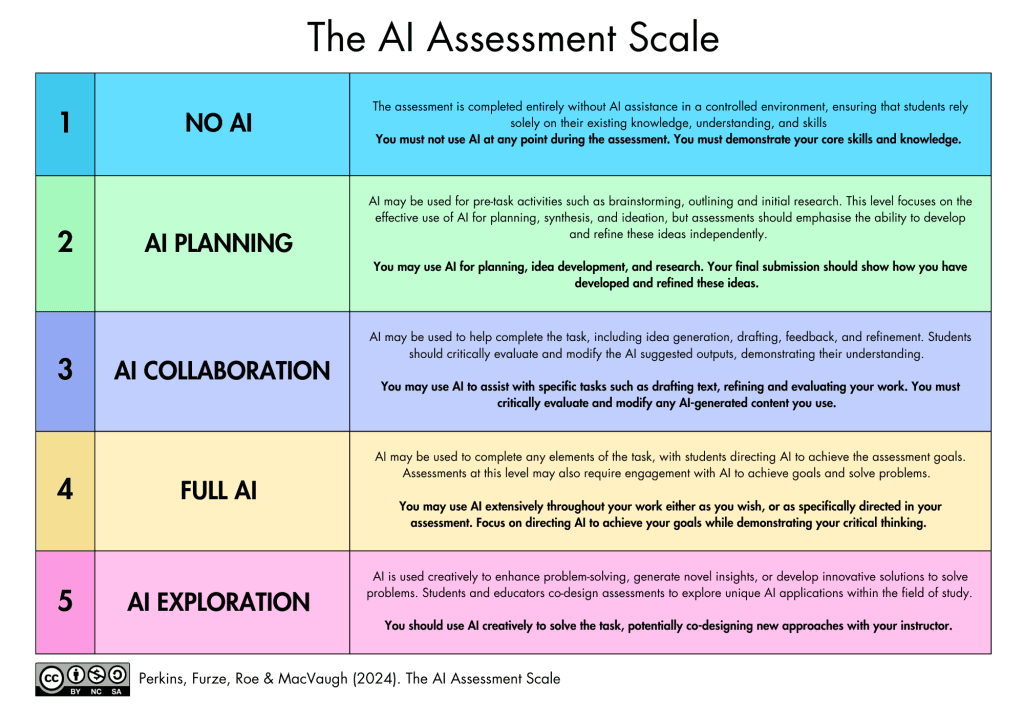
The attached diagram traces to Leon Furze’s updated AI Assessment Scale, published on August 28, 2024. It became a useful reference point for thinking about when AI use is allowed, limited, or excluded in evaluation.
That framework matters because hiring is increasingly concerned with where human reasoning still needs to stand on its own.
Which skills employers are trying to isolate
These are the skills AI still struggles to replicate effectively in real-world settings: empathy, ethical reasoning, complex decision-making, and communication.
That creates a new layer in hiring. It is no longer enough to be technically capable. You also need to demonstrate human depth.
Why this changes how candidates should present themselves
Candidates who only describe tools or outputs can start to sound interchangeable. What stands out more is evidence of leadership, collaboration, judgment under uncertainty, and the ability to navigate real tradeoffs.
Those are signals that become more valuable as AI handles a larger share of repeatable work.
How Aladdin can surface these strengths
Aladdin helps highlight these qualities by giving candidates a way to present experiences that showcase collaboration, decision-making, and real-world leadership rather than only technical labels.
In a world of automation, being human is an advantage.
- Show moments where you handled ambiguity or competing priorities.
- Highlight leadership and collaboration, not just output volume.
- Use examples that demonstrate judgment, ethics, or stakeholder trust.
- Balance AI fluency with proof of human reasoning.